








Big Vision behind Uttar Pradesh Master Plan 2041
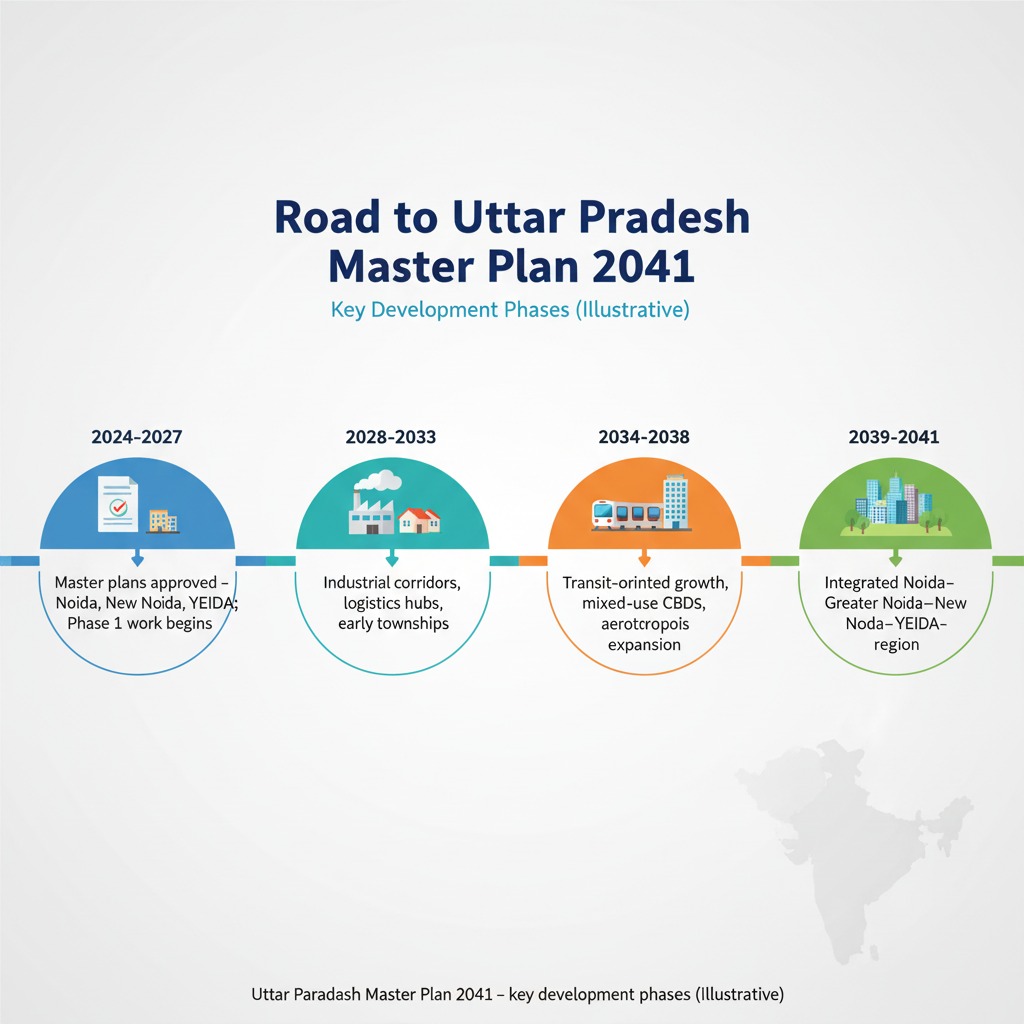
Uttar Pradesh Master Plan 2041 is a long‑term planning framework built around city‑specific master plans like Noida 2041, New Noida (DNGIR) 2041 and YEIDA 2041, which together aim to turn the state into a high‑growth, infrastructure‑rich and largely urbanised economy by 2041. These plans focus on industrial corridors, smart and green cities, aerotropolis‑led growth around Jewar Airport, and balanced land use so that housing, jobs and transport grow together.
Instead of one single “UP 2041 map”, the state follows multiple coordinated master plans prepared by development authorities for different regions—Noida, Greater Noida, New Noida, YEIDA and others. Collectively, they support the broader agenda of making Uttar Pradesh a multi‑trillion‑rupee economy with strong manufacturing, logistics, services, tourism and digital infrastructure.
Core objectives across these 2041 plans include:
- Creating employment‑rich economic hubs with world‑class industrial and logistics infrastructure, especially along expressways and freight corridors.
- Building smart, sustainable cities with robust public transport, green spaces, digital governance and climate‑resilient utilities.
- Integrating regional growth so that New Noida, YEIDA, Greater Noida and existing cities function as one connected metropolitan belt around Delhi NCR.
Noida & New Noida Master Plan 2041
Noida Master Plan 2041 largely centres on expanding the Dadri–Noida–Ghaziabad Investment Region (DNGIR), popularly called New Noida, as a new industrial‑cum‑residential city spread over roughly 21,000 hectares. Around 80–84 villages in Gautam Budh Nagar and Bulandshahr are being brought into this project, with development to be rolled out in four phases up to 2041.
Land use in New Noida 2041 is tilted strongly towards jobs and industry: about 40% of land for industrial areas, 13% for residential, 18% for green and recreational spaces, 8% for institutional uses and 4% for commercial zones. The city is expected to accommodate roughly 6 lakh residents and will be supported by wide roads, logistics hubs, smart traffic management, and digital surveillance systems.
Phase‑Wise Development of New Noida
New Noida’s master plan clearly defines four phases so that infrastructure and real estate can grow in an organised manner. Each phase adds more land, industries and housing, with completion of the full city targeted by 2041.
- Phase 1: About 3,165 hectares targeted for completion by 2027, focusing on initial industrial clusters, logistics, and supporting housing.
- Phase 2: Around 3,798 hectares to be developed by 2032, expanding industrial zones and launching larger residential and commercial projects.
- Phase 3: Nearly 5,908 hectares by 2037, with more specialised industrial parks, educational hubs and premium housing.
- Phase 4: Total developed area reaches about 8,230 hectares by 2041, completing the New Noida city with a full mix of industrial, residential, commercial and institutional zones.
For investors, this timeline helps in planning both short‑term and long‑term positions—early phases for faster visibility, later phases for land‑banking and higher potential appreciation.
YEIDA Master Plan 2041 and Aerotropolis Vision
The YEIDA Master Plan 2041 extends far beyond the current Yamuna Expressway sectors, covering 226 villages across districts like Gautam Budh Nagar and Bulandshahr. Its central idea is to build an “Aerotropolis” around Jewar International Airport, with airport‑linked industrial, logistics, tourism and service zones.
Key elements of YEIDA 2041 include:
- Creation of an aviation‑led economic region with cargo hubs, MRO facilities, logistics parks and export‑oriented industrial estates.
- Strong multi‑modal connectivity through expressways, Metro/Metro‑Neo, bus systems and even cycle tracks to make the region attractive for both workers and residents.
- Emphasis on green buffers, flood‑zone management along Yamuna, and eco‑tourism clusters so that rapid growth does not compromise environmental stability.
This master plan is central to Western UP’s push to become a high‑value manufacturing and services corridor linked directly to global supply chains via the new airport.
Greater Noida Master Plan 2041
Greater Noida’s Master Plan 2041 builds on earlier 2031 plans by adding new villages, expanding industrial belts and refining land‑use norms for higher‑density mixed‑use sectors. The plan continues Greater Noida’s positioning as a low‑density, planned city but with more focus on transit‑oriented and compact growth near expressways and metro corridors.
Some of the important directions indicated in the 2041 framework are:
- Additional industrial and IT/ITES parks along Eastern Peripheral Expressway and other major roads.
- New residential sectors, group housing pockets and commercial centres designed to integrate with Noida, YEIDA and New Noida as one larger urban system.
- Increased provision for institutional land and green areas to keep liveability high as population and job density rise.
For developers already active in Greater Noida, the 2041 plan gives more clarity on where next‑generation sectors, institutional zones and mixed‑use corridors will come up.
Land Use & Zoning Themes Across 2041 Plans
Although each authority has its own map, some zoning themes are common across the 2041 frameworks.
- Industrial and logistics: Large contiguous zones earmarked for manufacturing, warehousing, data centres, and special economic activities, typically along expressways and major freight routes.
- Residential: A mix of plotted housing, group housing, affordable/EWS schemes and townships, often clustered around transit corridors and employment nodes.
- Commercial and business districts: City‑level CBDs, office corridors and mixed‑use sectors catering to retail, offices, hospitality and entertainment.
- Institutional and public facilities: Land for universities, research parks, hospitals, sports complexes (including planned Olympic facilities), and government offices.
- Green and recreational: Urban forests, riverfront buffers, parks, stadiums and eco‑zones to maintain environmental balance.
The New Noida example—40% industrial, 13% residential, 18% green, 8% institutional and 4% commercial—shows how strongly the 2041 plans tilt towards employment and sustainability together.
Role in Uttar Pradesh’s Wider 2047–2050 Vision
These 2041 city‑level master plans feed into broader state strategies such as the “Viksit UP 2047” vision, which targets deep urbanisation and high‑quality infrastructure across Uttar Pradesh. The idea is that by building strong regional economic zones around Noida–Greater Noida–YEIDA–New Noida, the state can attract global investment while also decongesting older cities.
Targets described in the wider vision include sharply increasing the share of population living in urban areas, universal access to basic services, and metro or modern transit in major urban centres. The 2041 master plans provide the spatial and regulatory backbone needed to reach those milestones—deciding where exactly new townships, industries, logistics parks and greenfield cities will sit on the ground.
Why 2041 Master Plans Matter for Real Estate
For real estate entrepreneurs, the 2041 master plans are essentially the “future map of money” in Uttar Pradesh.
- They signal where industrial and employment hotspots will appear, which directly drives demand for housing, retail and offices.
- They show which villages and peri‑urban belts will be urbanised, helping investors choose early‑stage land‑banking locations with clear acquisition and zoning roadmaps.
- They reduce planning risk: projects aligned with notified land use, FAR norms and infrastructure corridors are more likely to get timely approvals and sustained buyer interest.
As a broker or developer working around Noida, Greater Noida, YEIDA and Yamuna Expressway, building deep content around “Noida & YEIDA Master Plan 2041”, “New Noida 2041 phases”, and “Jewar Aerotropolis & YEIDA 2041” can position your brand as the go‑to advisor for long‑horizon investments in Western UP.