











AAI Height Construction Restrictions at Jewar Guidelines Around Noida International Airport (NIA): Complete YEIDA Compliance Guide
complete guide to height Construction Restrictions at Jewar around Noida International Airport (NIA). Learn about AAI NOC requirements, YEIDA bylaws, 10–20 km zoning limits, and penalties for non-compliance to ensure safe, compliant development.
As the Noida International Airport (NIA) near Jewar in Uttar Pradesh nears completion, the surrounding region has witnessed rapid real estate growth. Residential projects, commercial hubs, and industrial ventures are emerging quickly, anticipating massive economic and infrastructural benefits.
However, with this surge comes a strict regulatory framework set by the Airports Authority of India (AAI) and the Yamuna Expressway Industrial Development Authority (YEIDA). These rules primarily revolve around height restrictions, construction bans, and mandatory NOC (No-Objection Certificates) to ensure flight safety and airspace security as the airport becomes operational.
Understanding these norms is crucial not only for developers and architects but also for investors, local authorities, and even farmers whose land falls within the airport influence zone.
Why Noida International Airport Has Height and Construction Restrictions
The key objective of these guidelines is simple—to protect flight paths and air navigation systems. Airports require a clear and obstacle-free airspace for the safe takeoff, landing, and operation of aircraft. Even minor vertical intrusions, such as tall buildings or trees, can disrupt radar visibility, communication equipment, and pilot sightlines.
The restrictions are based on standard international safety norms under the International Civil Aviation Organization (ICAO). The AAI’s Colour-Coded Zoning Map (CCZM) translates these aviation safety rules into practical, location-based height limits that developers must follow.
In short, the zoning restrictions around NIA act as a buffer zone for flight safety — balancing regional urban development with global aviation standards.
Key Zones Around Noida International Airport
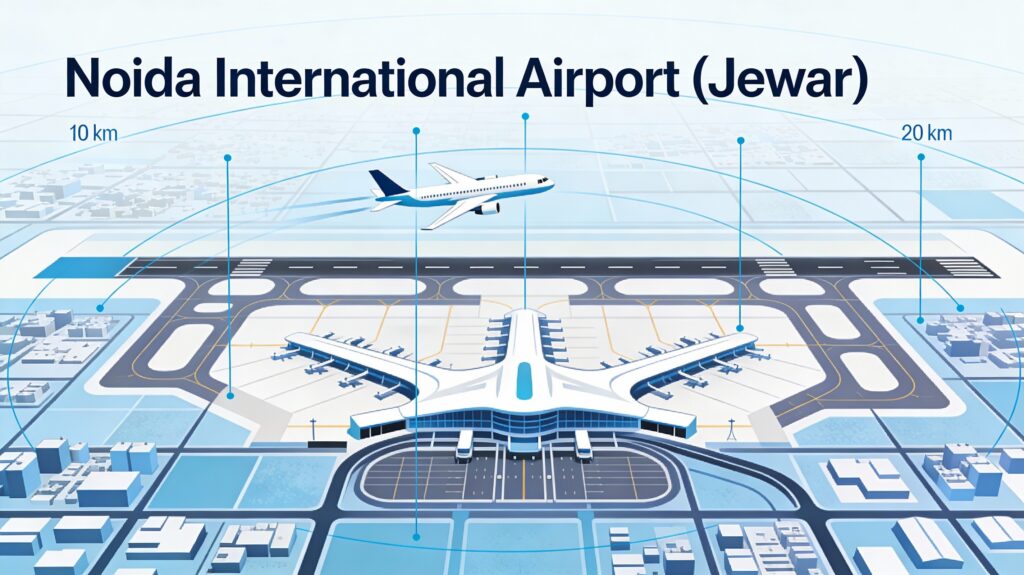
The NIA region has been divided into specific regulatory zones, mainly within 10 km and 20 km radii around the airport site.
- Core Zone (Within 10 km)
This is the most sensitive area for construction activity.
- Construction Ban: No unauthorized construction or tree plantation is permitted.
- Mandatory Clearance: Every structure, including residential, commercial, and industrial buildings, requires an AAI NOC and YEIDA approval.
- Strict Enforcement: Any non-compliant building faces heavy penalties or even demolition.
- Outer Zone (10–20 km)
This area allows limited development but with controlled vertical heights.
- Height Clearance: Any structure exceeding 15 meters requires an NOC from the AAI via the NOCAS online portal.
- Conditional Approvals: Projects are evaluated based on the AAI’s Colour-Coded Zoning Map (CCZM) before YEIDA sanctions the building plan.
- Tree Planting Restrictions: Even tall tree planting must comply with flight safety restrictions.
These zones ensure the approach and departure paths of aircraft remain clear and secure.
Mandatory AAI NOC: What Developers Must Know
Obtaining an AAI NOC is the first and most essential step before starting any construction within the airport influence area. It applies to both new projects and existing buildings wanting renovation or height additions.
AAI NOC requirements include:
- Location Details: Plot coordinates (latitude, longitude) and elevation above mean sea level.
- Project Details: Maximum height, floor plans, and total structure type (residential, commercial, etc.).
- Submission on NOCAS Portal: All applications go through the AAI NOCAS system — a digital platform that automates review and approval workflow.
- Evaluation Against CCZM: AAI compares proposed height with permissible limits from the Colour-Coded Zoning Map.
- NOC Issuance: Once approved, the developer can proceed with plans and submit the AAI clearance to YEIDA for building approval.
Note: Without AAI clearance, YEIDA will not issue the final building plan sanction.
YEIDA’s Role and Revised Building Bylaws
The Yamuna Expressway Industrial Development Authority (YEIDA) acts as the regional planning body enforcing construction norms around Noida International Airport. Over the past few years, YEIDA has revised its building bylaws specifically to align with AAI and DGCA safety norms.
The main points from YEIDA’s revised bylaws include:
- Integration with CCZM: All layout and elevation maps must be verified against respective colour-coded permitting zones.
- Maximum Permissible Height: Varies depending on plot distance and direction from the airport.
- Dual Clearance Requirement: Developers must first obtain an AAI NOC and then apply for YEIDA’s construction approval.
- Prohibited Activities: Unauthorized land filling, tree plantation of certain heights, and telecom tower installations without approval are banned.
These bylaws not only ensure compliance but also streamline urban design around the upcoming airport city.
How to Apply for AAI NOC Through the NOCAS Portal
To simplify the process, AAI provides a dedicated online platform — NOCAS (No Objection Certificate Application System). Here’s the step-by-step process:
- Register on NOCAS: Create an online account on the AAI NOCAS website.
- Enter Project Location: Input latitude and longitude accurately from GPS or site survey data.
- Upload Documents: Include building maps, ownership proof, and elevation drawings.
- Check CCZM Limits: The portal automatically evaluates permitted height for that area.
- Pay Fees: Based on project type and height sought.
- Receive NOC: If approved, download the official document and attach it with your building plan submission to YEIDA.
Using the digital system ensures transparency and traceability, drastically reducing the time taken for aviation clearance.
Enforcement and Penalties
The AAI and YEIDA strictly monitor the regions surrounding the airport using aerial mapping, drone surveys, and satellite imagery. If a structure violates height restrictions or bypasses NOC procedures, authorities can impose penalties such as:
- Demolition orders for illegal structures.
- Heavy fines for non-compliance under YEIDA and AAI bylaws.
- Suspension of building approvals for developers or agencies involved.
Local bodies and developers must therefore ensure full adherence before starting any excavation or foundation work.
Implications for Developers and Local Authorities
For developers, project managers, and municipal authorities, these compliance requirements are non-negotiable. Failing to follow AAI-approved limits not only risks financial loss but can also halt projects indefinitely.
Key action points include:
- Consult the CCZM: Before even finalizing a site, verify permissible height through the official map.
- Apply Early: Initiate AAI NOC applications during the design phase to avoid later delays.
- Coordinate with YEIDA: Post AA NOC clearance, ensure your building drawings adhere to revised bylaws.
- Maintain Documentation: Keep all NOC-related paperwork for future audits or resale transactions.
This proactive approach helps maintain both project timelines and investor confidence.
YEIDA’s Colour-Coded Zoning Map (CCZM): The Core Compliance Tool
CCZM is perhaps the most critical regulatory document for any construction near the airport. It outlines permissible building heights across different buffer zones, each defined by distinct colours.
Each colour corresponds to specific height thresholds — for example:
- Red: Severe restriction zones, closest to flight paths.
- Yellow: Moderate restriction zones (limited vertical profile).
- Blue/Green: Permissible for taller structures within safety range.
By overlaying your plot coordinates on the CCZM map, you can quickly identify the applicable maximum height and whether an NOC is required.
Why These Rules Are Necessary
Every airport around the world enforces similar vertical and zoning controls for one fundamental reason — aviation safety. The NIA project, being designed as a major international hub, needs completely clear corridors for takeoff and approach routes.
These restrictions help:
- Maintain safe separation between aircraft and ground structures.
- Protect radar systems and navigation aids from signal interference.
- Prevent unplanned or unsafe urban sprawl near critical aviation infrastructure.
- Support long-term airport expansion and future runway development plans.
In essence, these guidelines form the foundation for safe, smart, and sustainable airport-city development.
Impact on Real Estate and Urban Planning
From an urban perspective, these restrictions are reshaping the landscape of the Yamuna Expressway region. Developers are now focusing on horizontal layouts such as plotted developments, farmhouses, and low-rise communities.
High-rise apartments and skyscraper-style offices are being planned further away from the 20 km radius. This shift is not a setback — it’s a strategic adaptation that encourages green, eco-friendly, and aviation-compatible design principles.
For investors, properties located within the AAI-compliant zone carry higher long-term value as they will never face future demolition or approval issues.
Airport Readiness and Operational Progress
The Noida International Airport is approaching operational readiness, with Operational Readiness and Airport Transition (ORAT) trials already underway. These trials test everything from passenger movement to security, baggage systems, and cargo handling.
Highlights of upcoming operations include:
- Passenger Focus: Seamless movement, digital boarding, and full accessibility for all passengers, including wheelchair users.
- Cargo Facilities: Specialized cargo terminals equipped for food, pharma, and e-commerce logistics.
- Smart Infrastructure: The airport is adopting modern automation systems for terminal management, ensuring timely and efficient operations.
This focus on technology-backed efficiency will make NIA one of India’s most advanced airports while reinforcing the importance of surrounding land-use discipline.
Future Outlook
Once operational, Noida International Airport is expected to transform the entire Yamuna Expressway corridor into a new economic powerhouse. The region will attract logistics centers, hospitality projects, and aviation-linked industries.
However, sustainable growth depends on strict adherence to AAI and YEIDA regulations. Developers aligning early with these rules will hold a competitive advantage, both in compliance and credibility.
Conclusion
The development restrictions around Noida International Airport are not obstacles — they are safety pillars that ensure smooth airport functionality and sustainable regional growth. Developers, planners, and landowners must respect height limits, secure AAI NOCs, and comply with YEIDA’s revised bylaws before breaking ground.
With proper planning and timely approvals, this transformative infrastructure project can unlock vast real estate potential — responsibly and legally — while keeping India’s newest international airport safe for generations to come.